
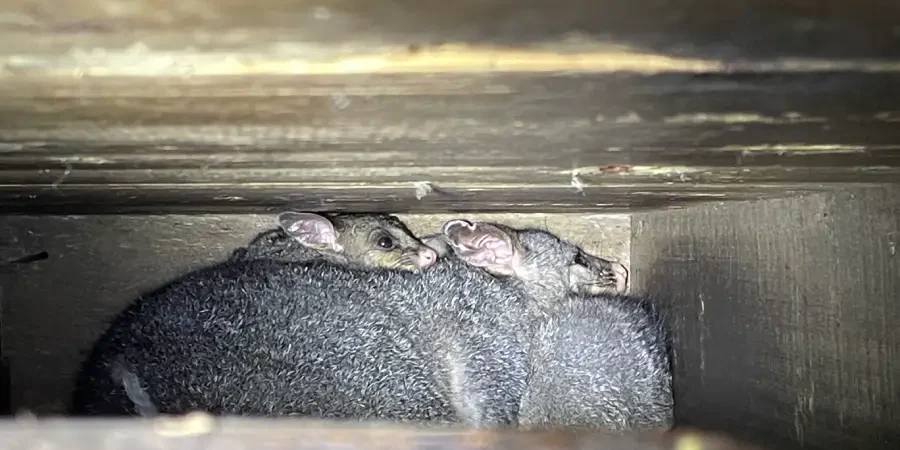
If something is thumping around your Perth roof at night, a possum is one possibility, and possums are protected native animals in Western Australia. You should not kill, injure or move them. The first step is to confirm what it is. Getting a possum out and closing the roof afterwards should be done with advice from DBCA or an authorised wildlife professional, because a possum or dependent young can be trapped inside if an entry is closed at the wrong time.
The Department of Biodiversity, Conservation and Attractions (DBCA) publishes the state’s guidance on possums, and this article follows it. Below you will find how to tell a possum from a rat, the steps you can take yourself, what to leave alone and when to get help.
Is it a possum or a rat?
Do not assume. Droppings and noise are only a guide. Noise in the roof can come from possums, rats, mice or even reptiles and goannas. DBCA says possum droppings are usually over 2 cm long, rat droppings about 1.5 cm and mouse droppings under 1 cm.
| Clue | Possum | Rat | Mouse |
|---|---|---|---|
| Droppings | Over 2 cm long | About 1.5 cm | Under 1 cm |
| Noise | Heavy thumps and movement at night, often shortly after dusk and before dawn | Scratching, scurrying and gnawing | Light scratching and squeaks |
| Other signs | Night-time noise, droppings and urine | Gnawed timber or wiring and greasy marks along runs | Small droppings and nesting material |
| Legal status | Protected native animal | Pest, can be controlled | Pest, can be controlled |
Droppings and noise do not confirm what is in the roof. If you are unsure, ask a professional to inspect before you act. If the signs point to a rodent, see our rodent control page, which explains the options. Our guides to mice in the roof in Perth and the roof rat show what those signs look like.
Two possum species live in Perth’s suburbs. The common brushtail is 35 to 55 cm long with silver-grey fur and a bushy tail. The western ringtail is about half the size, and it is listed as Critically Endangered. If you think you have seen a western ringtail, DBCA asks you to email a photo or description to fauna@dbca.wa.gov.au.
Why you cannot just remove it
All native fauna is protected under state and Commonwealth law. Under DBCA’s guidance, it is an offence to intentionally or recklessly kill, injure, trade, keep or move possums unless authorised. Shooting possums is not permitted, and depending on the activity a DBCA licence may be required.
DBCA also says relocating possums is largely unsuccessful and not humane, because animals can die from predation and stress after release. Possums can bite and scratch and may carry viruses, which is why only trained and licensed people should handle them.
What getting a possum out involves
DBCA’s method does not involve trapping. The possum leaves on its own and the roof is closed behind it. This is not a general do-it-yourself job, because a possum or its young can be trapped inside if an entry is closed too early. Get advice from DBCA or an authorised wildlife professional first.
- Find the entry point. Look for gaps at the eaves, damaged roof tiles, vents and gaps where a branch touches the roof. Work out which one the possum uses.
- Get advice before blocking openings. A wildlife professional or DBCA can tell you which openings can be closed and when, and how to confirm nothing is inside.
- Let the possum leave on its own. Possums usually leave at dusk to feed, but do not assume the roof is empty. Young may still be inside.
- Close the last entry point only when the roof is confirmed empty. If a possum or young may still be inside, do not close it.
- Make permanent repairs in daylight. If you hear scratching or distress after an entry is closed, seek immediate advice from DBCA or an authorised wildlife professional. Do not climb onto the roof yourself.
- Clean the access points. Wash them with disinfectant to remove scent trails.
Check for young before any entry is closed. DBCA’s guide does not cover breeding timing, so contact DBCA or an authorised wildlife professional before excluding a possum from a nest. If the roof is steep or high, use a licensed tradesperson. Do not go into a roof void without proper safety gear. If the roof space is not safely accessible, ask a professional to inspect it rather than investigating yourself.
What not to do
- Do not trap and release it elsewhere unless you are authorised.
- Do not poison, shoot or injure it, and do not close an entry while a possum or young may be inside.
- Do not rely on scaring techniques. DBCA says they are not effective.
- Do not leave pet food out at night or keep open compost.
Making the roof less attractive
- Fit sheet metal collars around tree trunks and remove low branches that give the possum a way onto the roof.
- Trim branches that hang over the roof, cars and patios.
- Offer an alternative den, such as a hollow log blocked at one end or a home-made nest box, to keep possums nearby but out of the roof.
- Use a closed compost system and bring pet food inside at night.
When to call for help
- If a possum is sick, injured or an orphan, call the Wildcare Helpline on (08) 9474 9055.
- If it is a western ringtail, email DBCA at fauna@dbca.wa.gov.au.
- If you are not sure what is in the roof, an inspection by a professional can tell you.
If you need a hand working out what is in your roof, see our page on possum control in Perth, or contact Tom’s Pest Control Perth through our contact page and we will explain what is possible for your property.
Questions about possums in the roof
Can I trap a possum and release it somewhere else?
Not without authorisation. It is an offence to move possums unless authorised, and DBCA says relocation is largely unsuccessful because many animals die after release.
Is it legal to kill a possum in my roof in Perth?
No. Possums are protected native animals, and it is an offence to intentionally or recklessly kill or injure them. Shooting is not permitted.
How do I know it is a possum and not a rat?
Droppings can help, but they do not confirm it. DBCA says possum droppings are usually over 2 cm long, rat droppings about 1.5 cm and mouse droppings under 1 cm.
Will possums leave on their own?
They usually leave at dusk to feed, but entry points should only be closed once the roof is confirmed empty, ideally with advice from DBCA or an authorised wildlife professional. If the openings stay unrepaired, they can come back.
What if I think it is a western ringtail?
Do not disturb it, and email a photo or description to DBCA at fauna@dbca.wa.gov.au. The species is Critically Endangered.
This guide is general information and not legal or wildlife advice. Rules can change, so check with DBCA or an authorised wildlife professional before you act.